
How to use catalogue capacity tables with storage-temperature correction factors, the apple cold-storage example (3.5 kW / R404A), and refrigerant notes — for A / AG / AC unit coolers.
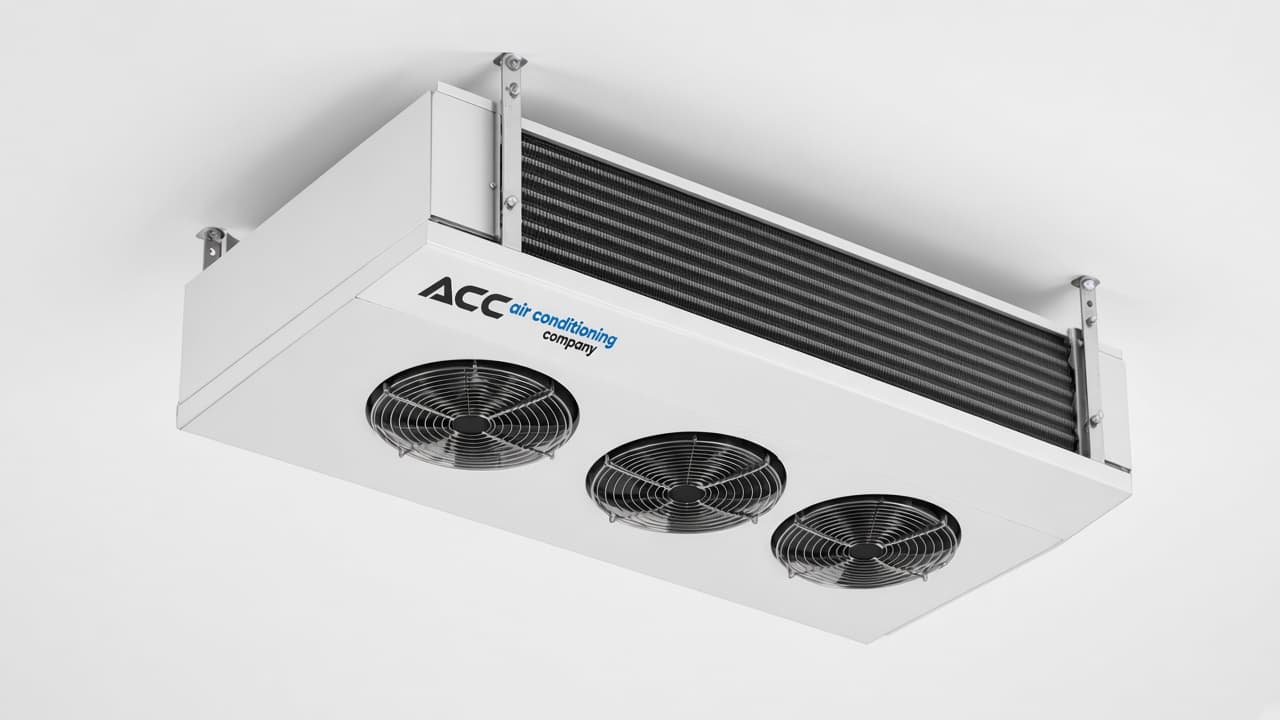
Start from room duty, not the first kW column
Catalogue air-cooler tables publish cooling capacity under a reference condition. Real rooms differ in storage temperature, frost load, refrigerant and ambient on the condenser side. Treat the tabulated kW as a starting point: correct for storage temperature (and refrigerant where the maker publishes factors), then pick the smallest model that still covers the corrected load including fan and electric-defrost heater contribution.
Fin pitch comes first. On the ACC catalogue lines, 4.5 mm fins target medium-to-high temperature storage around 0 °C, 6 mm suits medium temperature around −18 °C, and 9 mm suits medium-to-low duty around −35 °C. Choosing a pitch that is too tight for a low-temperature room raises frost risk and cuts effective capacity between defrosts.
Storage-temperature correction factors
For deep-freeze selection the catalogue lists cooling-capacity correction factors against storage temperature. Relative to the −35 °C reference (factor 1.00), published multipliers are: −30 °C → 1.08; −35 °C → 1.00; −40 °C → 0.85; −45 °C → 0.75; −50 °C → 0.66. If your room sits colder than the table reference, multiply the model’s listed kW by the factor before comparing it to the calculated room load — or, equivalently, divide the required load by the factor to see what catalogue kW you must buy.
Example: a quick-frozen pork store at −35 °C, +35 °C ambient, evaporation −42 °C at 6 K TD, required cooling 20.5 kW including fan and electric heating load, refrigerant R507A. At −35 °C the factor is 1.00, so you need a published model at or above 20.5 kW on the matching low-temp fin table — the catalogue concludes with an A22.7E9G-class selection.
Worked example: apple cold storage
The catalogue’s positive-temperature example is an apple cold store. Design inputs: required storage temperature 0 °C; ambient +35 °C; evaporation −6 °C at 6 K TD (recommended); cooling capacity 3.5 kW including fan and electric heating load; refrigerant R404A.
With ~0 °C storage you stay on the 4.5 mm fin family (A4.5 or AC-E4.5). The compact A table opens with A3.5E4.5-301 at 3.5 kW — a direct match for this duty once the engineer confirms air throw, defrost schedule and condenser match. If the corrected load were higher, step through A4.9E4.5-401, A7.7E4.5-302 and so on until capacity and fan count fit the room.
Refrigerant factors
Published cooler capacities are tied to a reference refrigerant in the selection notes. The worked examples use R404A (apple store) and R507A (deep-freeze). When the plant runs a different fluid — for example R134a on a medium-temperature room or another blend on a freeze pack — apply the manufacturer’s refrigerant capacity factor to the tabulated kW before you compare it with the room load. Do not assume 1:1 transfer between refrigerants; pressure–temperature behaviour and mass-flow change the coil duty.
In practice: (1) calculate room load including infiltration, product, lighting, fans and defrost recovery; (2) choose fin pitch from storage class; (3) apply storage-temperature correction if you are off the table reference; (4) apply the refrigerant factor for your fluid versus the catalogue reference; (5) pick the model whose published kW still exceeds the corrected requirement. ACC can cross-check A / AG / AC cooler tables and ACI / FV / IKA condensers once you send temperature, refrigerant and load.
Condenser side of the same project
Unit-cooler selection is only half of the outdoor balance. Heat rejected at the condenser is roughly the evaporator duty plus compressor input. Match ACI (flat multi-fan), FV/AI (V-type high capacity) or IKA (box, top discharge) frames to design ambient and required rejection, using the published kW and dimension rows. Coil circuits in this catalogue family are factory pressure-tested in the ~3.0 MPa class.