
Review the basic practices for safely storing, securing, labelling and transporting pressurised refrigerant cylinders.
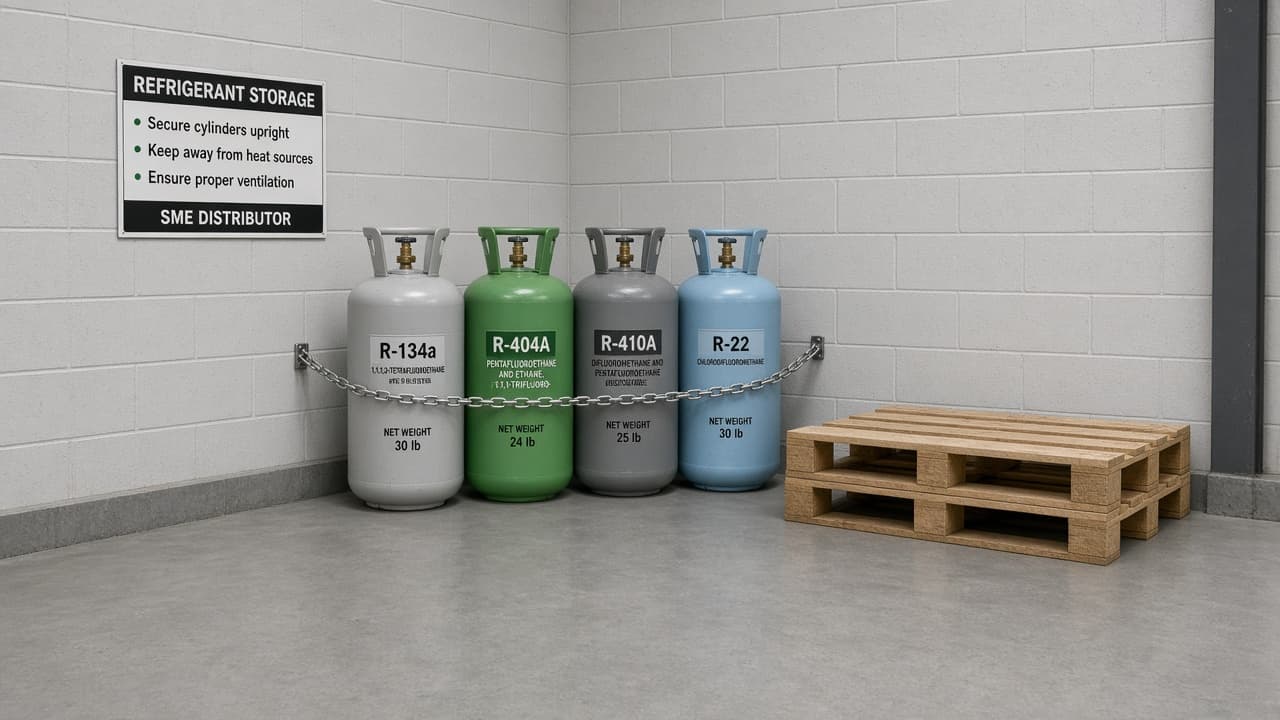
Cylinder orientation and securing
Store and transport refrigerant cylinders upright unless the manufacturer explicitly allows another orientation for a specific package type. Secure against tipping with chains, straps or racks designed for gas cylinders.
Protect valves with caps or guards when cylinders are not connected to manifolds. Keep labels and hazard pictograms readable so pickers select the correct ASHRAE/ISO code.
Temperature, ignition and ventilation
Keep cylinders away from heat sources, direct intense sun where temperatures can exceed cylinder ratings, and ignition sources — especially for A2L fluids such as R32. Follow SDS temperature guidance.
Storage rooms need ventilation appropriate to the hazard class and local code. Do not store cylinders in unventilated basements or occupied offices.
Segregation by fluid and class
Segregate A2L R32 from A1 stocks such as R410A and R134a when site rules require hazard-class separation. Use clear shelf labels and colour cues that match your inventory system.
Never mix recovered refrigerants of different codes in the same recovery cylinder. Cross-contamination complicates reclaim and can make fluid unusable for recharge.
Transport readiness
Before dispatch, confirm SDS accompanies the load or is accessible to the driver under your logistics SOP. Check that cylinder valves are closed, caps fitted and packages secured against movement.
Declare the correct transport classification from the SDS. Quantity limits and vehicle requirements depend on the fluid and packaging — coordinate with your carrier for ADR/IMDG or local rules as applicable.
ACC logistics notes
When ordering from ACC, state delivery site constraints: forklift access, receiving hours and any A2L storage rules. That helps align cylinder sizes and delivery windows with warehouse readiness.
Pair cylinder orders with SDS/TDS requests so HSE clearance is ready when stock arrives. Contact can coordinate multi-code shipments across R32, R410A, R134a, R404A and R407C.