
We explain the role of refrigerants in the refrigeration cycle, how they work with the evaporator, compressor, condenser and expansion device, and the main applications.
What is a refrigerant gas?
A refrigerant (often called soğutucu gaz or klima gazı in Turkish trade talk) is the working fluid inside a closed refrigeration or air-conditioning circuit. It absorbs heat where cooling is needed and rejects heat elsewhere by changing pressure and phase — typically evaporating and condensing in a repeating cycle.
In HVAC/R (heating, ventilation, air conditioning and refrigeration), refrigerants are selected to match equipment design: temperature level, pressure envelope, lubricant, safety class and regulatory constraints such as GWP. The fluid does not “create cold” by itself; it moves heat from a cold space to a warmer sink.
The vapor-compression cycle
Most commercial AC, cold rooms, chillers and many heat pumps use the vapor-compression cycle. Four components do the main work: evaporator, compressor, condenser and expansion device. Phase change is the practical engine of heat transfer — latent heat during evaporation and condensation dwarfs the sensible heat of a simple temperature rise.
Evaporator
In the evaporator, low-pressure liquid refrigerant boils and absorbs heat from air, water or a secondary fluid. That is the “cooling” the room or process feels. Coil design, air flow and superheat control keep liquid from returning to the compressor in damaging amounts.
Compressor
The compressor raises the pressure (and temperature) of refrigerant vapor so it can reject heat in the condenser. Displacement type, oil management and suction conditions must match the refrigerant’s pressure-temperature curve. Wrong fluid or wrong charge stresses the machine and shortens life.
Condenser
In the condenser, high-pressure vapor rejects heat to outdoor air or cooling water and returns to liquid. Dirty coils, blocked airflow or undersized condensers raise discharge pressure and energy use. ACC’s equipment range includes condensers and related cooling hardware used on the high side of many systems.
Expansion device and phase change
An expansion valve, capillary or electronic expansion device drops liquid refrigerant pressure before the evaporator. Part of the liquid flashes to vapor; the rest evaporates while absorbing heat. Without controlled expansion, evaporator temperature and compressor suction conditions drift out of the design window.
Where refrigerants are used
Comfort air conditioning — splits, multi-splits, VRF/VRV and rooftops — is a large share of HFC demand. Heat pumps use the same cycle in reverse or reversible mode for heating. Automotive AC historically relied heavily on R134a; newer vehicles may use lower-GWP options depending on OEM design.
Commercial refrigeration covers display cabinets, food retail and light cold rooms. Industrial refrigeration and large cold stores push lower temperatures and higher capacities. Chillers cool water or glycol for process and building loads. Across these duties, fluid choice follows the machine design — not preference alone.
ACC refrigerant products at a glance
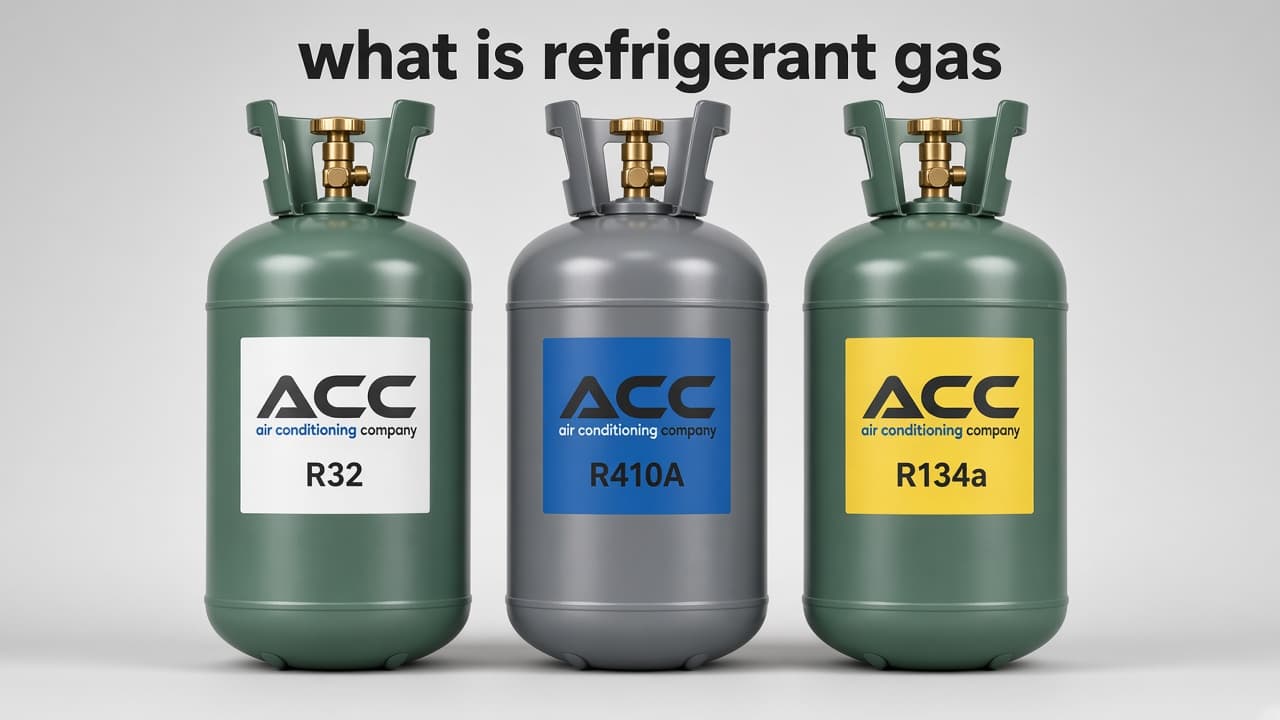
ACC İklimlendirme offers five refrigerants for B2B supply: R32, R410A, R134a, R404A and R407C. Product pages summarise typical applications, ASHRAE safety class and GWP/ODP figures. Always confirm fit against the equipment nameplate and manufacturer instructions before charging.
R32
R32 (difluoromethane) is a single-component HFC used widely in newer split AC and some heat pumps. It has lower GWP than R410A but is classified A2L (lower flammability), so charge limits, leak detection and installer competence rules apply. Do not drop R32 into an R410A system unless the OEM explicitly allows a conversion path.
R410A
R410A is a near-azeotropic HFC blend long used in residential and light commercial AC. It operates at higher pressures than older R22 systems and typically uses POE oil. Many installed systems still use R410A; retrofit decisions must respect pressure ratings and OEM guidance.
R134a
R134a is a pure HFC used in automotive AC, medium-temperature commercial refrigeration and many chillers. It is typically A1 (lower toxicity, no flame propagation under standard tests) with ODP of zero. Selection still depends on GWP policy, equipment design and lubricant compatibility.
R404A
R404A is a zeotropic HFC blend historically common in low and medium-temperature commercial refrigeration — cold rooms, freezers and food logistics. It has a high GWP, so many regions encourage lower-GWP alternatives for new equipment. Existing systems designed for R404A still need correct use and service of blend refrigerants and liquid-phase charging.
R407C
R407C is a zeotropic HFC blend used in some AC and heat-pump equipment, including certain retrofit contexts historically linked to R22 replacement. Temperature glide means composition can shift if vapor is charged incorrectly. Follow OEM charge method — usually liquid from a blended cylinder.
HFO and hydrocarbon refrigerants (brief)
HFO refrigerants (hydrofluoroolefins) are used in newer low-GWP designs; properties and flammability class vary by molecule and blend. Hydrocarbons such as R290 (propane) and R600a (isobutane) offer very low GWP but are A3 (higher flammability) with strict charge and installation limits. The current product range on this site focuses on the five HFC refrigerants named above — ask Contact for other codes if your project specifies them.
GWP, ODP and safety classes A1 / A2L / A3
GWP (global warming potential) compares a gas’s climate impact to CO₂ over a stated horizon (commonly 100 years, IPCC AR4 figures on many datasheets). ODP (ozone depletion potential) is zero for the ACC HFC products listed here; older CFCs/HCFCs were the ozone concern. ASHRAE safety class combines toxicity (A/B) and flammability (1 / 2L / 2 / 3). A1 is non-flammable under standard tests; A2L is lower flammability; A3 is higher flammability. Class drives charge limits, ventilation and tooling — not marketing preference.
Pure fluids vs blends
Pure fluids (R32, R134a) have a single boiling point at a given pressure. Zeotropic blends (R404A, R407C) show temperature glide: bubble and dew points differ, and leaking vapor can change composition. Near-azeotropic blends (R410A) behave closer to a pure fluid but still deserve OEM charging discipline. Never mix refrigerants in a circuit designed for one specified fluid.
Purchasing and use notes for buyers
The correct refrigerant must be selected from the manufacturer’s specified product code. Start from the equipment: nameplate refrigerant, oil type, design pressures and OEM service bulletin. Then discuss cylinder size and quantity with ACC. For tenders, list each ASHRAE/ISO code separately. If you are unsure, send the model plate photo with your enquiry rather than guessing a substitute.
Storage and handling
Store cylinders upright, secured, away from heat and ignition sources, with valves protected and labels readable. Segregate by hazard class where required. Use recovery equipment for service work; venting refrigerant to atmosphere is restricted in many jurisdictions. Follow the SDS for first aid, fire and spill guidance.
Technical documents
Serious refrigerant purchasing often needs SDS/MSDS for safety and transport, TDS for properties, and sometimes CoA for batch quality (purity, moisture, acidity, NCG, residue). ACC’s Documents centre and Quality & Documentation pages explain categories and how to request files by product code.
Professional service
Charging, recovery, leak repair and flammable-refrigerant work belong to trained technicians with suitable tools and local licensing where required. ACC İklimlendirme supplies products and technical documents to professional customers; system design and on-site work remain the responsibility of qualified HVAC/R professionals. For availability of R32, R410A, R134a, R404A or R407C — or related cooling equipment — use Contact with product code and quantity.