
We explain the main differences between pure refrigerants such as R32 and R134a and blends such as R410A, R404A and R407C, including temperature glide and service practice.
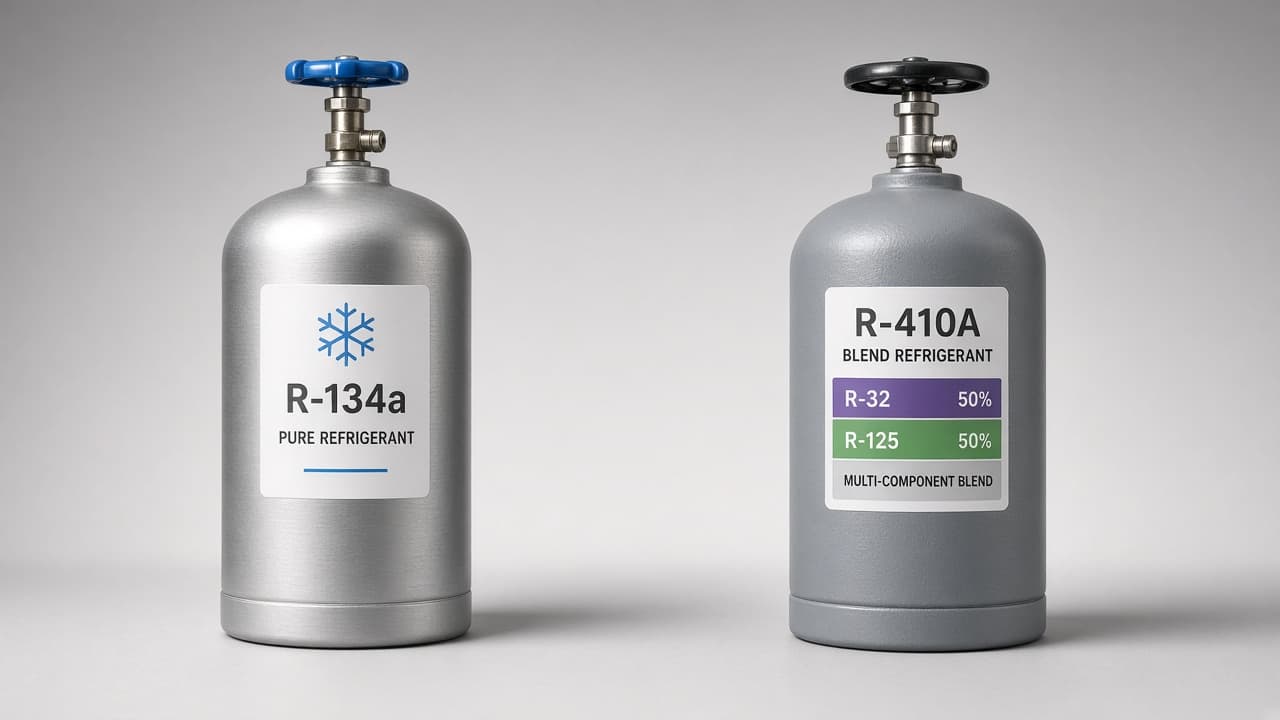
Pure fluids
Pure refrigerants such as R32 and R134a are single molecules. At a given pressure they have one saturation temperature, which simplifies PT-chart reading when the system is correctly charged and oil issues are under control.
Composition does not fractionate during a vapor leak the way zeotropic blends can. Leak repair and recharge still require professional leak finding and OEM charge targets.
Near-azeotropic blends
R410A is a near-azeotropic blend of R32 and R125. Bubble and dew points are close, so glide is small and field behaviour is nearer to a pure fluid than high-glide zeotropes.
OEM practice still prefers liquid charging from a blended cylinder to protect composition. Treat R410A as its own catalogue code — not interchangeable with pure R32.
Zeotropic blends and glide
R404A and R407C are zeotropic HFC blends with noticeable temperature glide. Evaporators and condensers see a temperature range rather than a single boiling point at constant pressure.
If vapor is charged or leaked preferentially, composition can shift and capacity or efficiency drifts. Liquid-phase handling from blended cylinders and segregated recovery keep identity intact.
Procurement implications
Write each ASHRAE/ISO code as a separate line item. “AC gas” or “cold-room gas” is not a specification. Match the nameplate, then choose cylinder size and quantity with ACC.
ACC’s current product range spans both pure and blend chemistries: R32 and R134a (pure); R410A (near-azeotropic); R404A and R407C (zeotropic). Document packs (SDS/TDS/CoA) should follow the same split.
Field and warehouse discipline
Label shelves and recovery cylinders with the exact code. Training should cover why blends need liquid charging and why pure A2L R32 needs different safety controls than A1 stocks.
Never mix refrigerants in a circuit designed for one specified fluid. If a conversion path exists, it comes from the OEM with parts, oil and procedure — not from drop-in substitutes without manufacturer approval.